Archaeological Museum of Olympia: Where History still has secrets to reveal
A journey 2,500 years back, among gods, heroes, great creators and authentic objects that changed the way we know ancient Greece.
There are museums that house great works of art. But there are also those that, behind each exhibit, hide a story so fascinating that for a moment you feel like time has stopped.
The Archaeological Museum of Olympia belongs to this rare category.
Imagine standing in front of the helmet of Miltiades, the general who linked his name to the Greek victory at Marathon. Gazing at a small clay cup bearing the name of Phidias, the artist who created one of the Seven Wonders of the Ancient World. Or standing opposite Praxiteles’ Hermes, a statue so human, you almost expect it to move. And that’s just the beginning…
In Ancient Olympia, where people gathered for centuries to honor Zeus and watch the Olympic Games, history remains alive.
Let's discover together some of its most fascinating secrets.
Praxiteles' Hermes – A masterpiece that still puzzles archaeologists
Inside a separate room of the museum, Hermes stands serenely, holding little Dionysus in his left hand.
His body seems to move naturally. His face exudes calm. The marble, despite its hardness, has acquired an almost human softness.
It is not difficult to understand why the statue is considered one of the most important masterpieces of ancient Greek art.
It was discovered in 1877, during the major German excavations, in the temple of Hera in Olympia.
His discovery caused enormous excitement in the scientific world.
The mystery behind its creator
The ancient traveler Pausanias had mentioned that in the temple of Hera there was a statue of Hermes holding the infant Dionysus, the work of the famous sculptor Praxiteles.
When archaeologists discovered the statue, the connection was striking.
And yet, one question still concerns experts.
Is this really an authentic work by Praxiteles or a later creation inspired by his art?
The opinions of scholars are not entirely unanimous.
This unanswered question adds even more charm to the work.
When you stand in front of him, take some time to observe the face, the posture, and the relationship between the two figures.
Perhaps you will discover what made ancient Greek sculpture unique: the ability to transform stone into a human presence.
The Helmet of Miltiades – A Silent Witness to Greek History
Among the museum's famous sculptures is an object less impressive in size, but invaluable in historical value.
A bronze Corinthian helmet.
On its surface is an inscription:
«MILTIADES, THEREFORE»
That is:
«Miltiades dedicated it to Zeus.».
Miltiades was the Athenian general who played a decisive role in the Battle of Marathon, in 490 BC, when Greek forces faced the Persian army.
That victory was destined to become one of the most important events in Greek history.
Today, more than 2,500 years later, the helmet that bears his name stands before our eyes.
Did he wear this helmet at the Battle of Marathon?
We cannot know this with absolute certainty.
Archaeologists associate the dedication with Miltiades and probably with the victory at Marathon, but it has not been proven that he wore this particular helmet in battle.
This, however, does not diminish its importance at all.
Instead, it offers us something extremely rare: an authentic object bearing the name of a real person, whom we know from historical sources.
A small inscription that connects today with one of the most important moments of ancient Greece.
A second helmet and an unexpected story from the Persian Wars
Here lies one of the museum's lesser-known historical secrets.
Another extremely interesting war object is exhibited near Miltiades' helmet.
This is an eastern-style helmet, which is associated with the Persian Wars.
What makes it special is its inscription.
«THE TWO ATHENS WHO TAKE MEDON»
Simply put:
«The Athenians dedicated it to Zeus, after they took it from the Medes.».
The ancient Greeks often used the name «Medes» when referring to the Persians.
The inscription reveals that the helmet was offered to Zeus as a spoil of war.
We don't know for sure which specific battle it comes from.
What we do know is that it is authentic testimony to the conflicts between the Greeks and the Persians at the beginning of the 5th century BC.
Why did the helmets end up in Olympia?
In ancient times, victors used to dedicate part of their war spoils to the gods.
The offering of a weapon to the Sanctuary of Zeus was an act of gratitude, but also a public display of a military success.
Thus, Olympia collected offerings from different Greek cities.
The result? A Sanctuary that, in addition to being a religious center, became a place to preserve the collective historical memory of the Greeks. And today, two ancient helmets allow us to mentally touch that era.
The Phidias Cup – A Humble Object with a Great Story
If there is one exhibit that proves that archaeology hides surprises, it is the small cup of Phidias.
Phidias was one of the greatest sculptors of antiquity.
In Olympia he created the famous gold and ivory statue of Zeus, a colossal work approximately 12 meters high.
The statue depicted the father of the gods seated on his throne and was among the Seven Wonders of the Ancient World.
The work is not preserved today.
However, excavations have revealed something that connects us to its creator in a completely different way.
A small clay cup, on which we read:
«I AM THIRSTY»
«I belong to Phidias.».
The discovery that helped identify an ancient laboratory
The cup was found in the area identified as the great artist's workshop.
Along with other archaeological finds, it was an important element in the identification of the building.
Imagine the place almost 2,500 years ago.
Craftsmen work on precious materials. Tools, molds, and objects lie around them. One of humanity's greatest works of art is gradually taking shape.
And somewhere there, a simple clay cup.
The emotion lies precisely in this contrast.
The statue that made Phidias immortal was lost. A small object bearing his name survived.
These are the stories that make archaeology so fascinating!
The Victory of Paeonios – A goddess descending from the sky
If there is one sculpture that seems to defy the laws of gravity, it is the famous Victory of Paeonios.
The goddess appears descending from the sky.
Her clothes flutter, her body moves dynamically, and the artist has given the marble a surprising sense of freedom.
The statue was created in the 5th century BC by the sculptor Paeonios, who came from Mendi, Chalkidiki.
It was a tribute of the Messenians and Nafpaktians to Zeus.
But behind its beauty lies a story of military victory and political rivalry.
The inscription that reveals the reason for the dedication
At the base of the statue was an inscription explaining that the Messenians and Nafpaktians dedicated the work to Olympian Zeus, offering one tenth of the spoils of war.
The dedication has been linked to the conflicts of the Peloponnesian War and probably to the victory against the Spartans in the area of Pylos and Sphacteria.
Victory did not simply symbolize an abstract idea.
It was a public declaration of success.
A monument that reminded anyone visiting Olympia of the power of those who dedicated it.
And another secret hidden in the inscription!
The base of the statue also includes a second, extremely interesting piece of information.
It states that Paeonios had emerged victorious in a competition for the creation of the capes of the temple of Zeus.
In other words, the inscription gives us information not only about the history of the statue, but also about the professional success of its creator.
A small detail that reminds us that even in ancient Greece, artists competed, stood out and claimed recognition for their work!
The Temple of Zeus – The mythical stories that come to life in marble
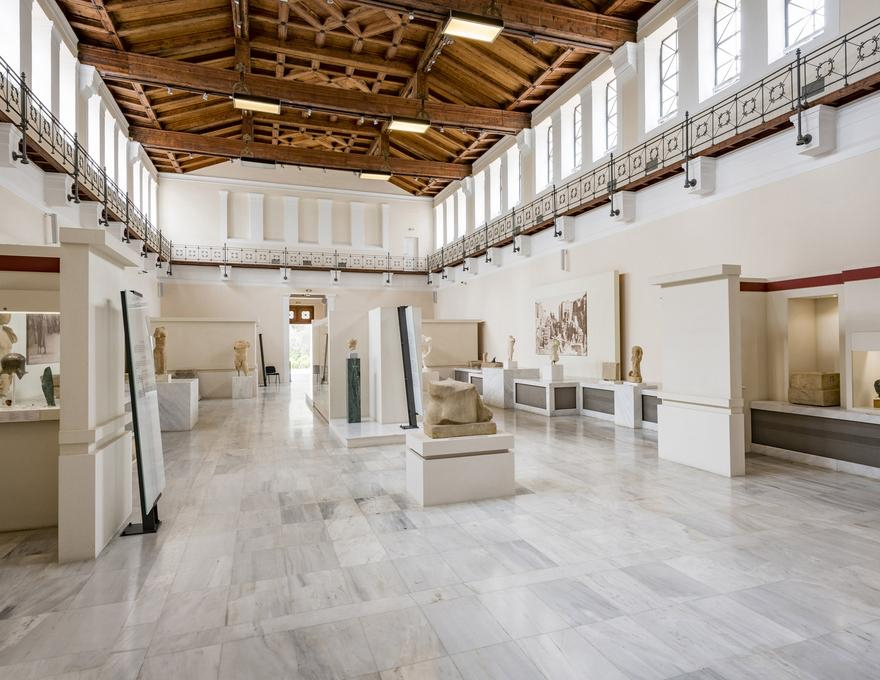
The large central hall of the museum hosts one of the most important collections of ancient Greek sculpture.
The sculptural decoration of the temple of Zeus.
The temple's famous pediments and metopes were created in the 5th century BC and are masterpieces of early classical art.
Each side of the temple told a different story.
Pelops, Oenomaus and a struggle with the prize of life
The eastern pediment depicts the preparation for a mythical chariot race.
The young Pelops wished to marry Hippodamia, daughter of King Oenomaus.
But the king had set a terrifying condition.
Anyone who wished to marry his daughter had to first defeat him in a chariot race.
The loser would lose his life.
According to the myth, Pelops managed to prevail, although his victory was associated with the sabotage of Oenomaus' chariot.
What does this story have to do with the Peloponnese?
Pelops was so closely associated with the area that tradition attributed the name to his name. Peloponnese — the island of Pelops.
Thus, the myth depicted in the museum is not just a beautiful ancient story.
It is associated with the mythological identity of the entire Peloponnese.
The battle of the Lapiths with the Centaurs
On the west pediment, a completely different scene unfolds.
The conflict between the Lapiths and the Centaurs during the wedding of Peirithus.
In the center is the majestic figure of Apollo.
The scene is often interpreted as a symbolic conflict between order and violence, self-control and uncontrolled impulse.
It is no coincidence that the sculptures were created at a time when Greek cities had recently faced the Persian invasion.
The labors of Hercules
The metopes of the temple depicted the Twelve Labors of Hercules.
From Atlas and the apples of the Hesperides to the Stymphalian Birds, the performances highlight the struggle, endurance and effort to overcome human limits.
Values that were deeply connected to the spirit of the ancient Olympic Games.
Zeus and Ganymede – A story from Greek mythology
Among the important exhibits is an impressive clay complex depicting Zeus carrying the young Ganymede.
According to Greek mythology, Ganymede was a young man from Troy, whom Zeus chose to be the cupbearer to the gods on Mount Olympus.
The work dates back to the 5th century BC and is an excellent example of large clay sculpture.
Why is it worth noting?
Because it reminds us that ancient Greek art was not limited to marble and bronze.
The craftsmen of the time also created impressive works of art from clay, demonstrating their high artistic and technical skill.
A museum worth discovering without rushing
The Archaeological Museum of Olympia is not just a place where ancient artifacts are kept.
It is a meeting place with history, mythology, art and culture that was born in this corner of Greece.
Here you will meet Hermes and Dionysus.
You will come across a helmet associated with Miltiades.
You will get to know Phidias through a small personal object.
You will discover that a statue can tell the story of a military victory and that an inscription can preserve the history of a person for thousands of years.
My advice
Don't just stick to the most famous exhibits.
Give time to the signs, the small objects, and the lesser-known rooms.
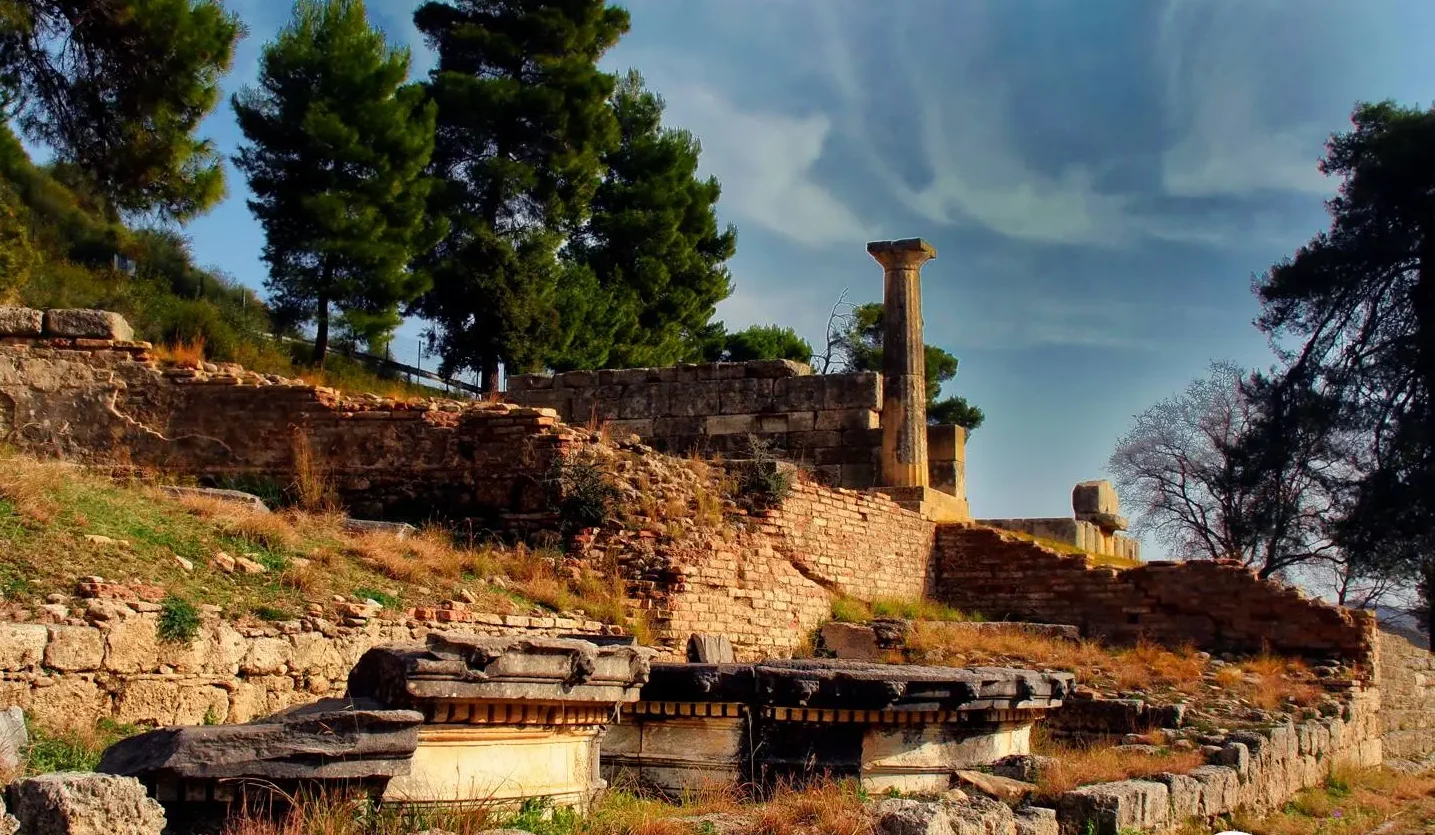
And, if you can, combine your visit to the museum with a tour of the archaeological site of Olympia.
There is something truly moving about admiring the sculptures of an ancient temple and then walking among the ruins of the monument itself.
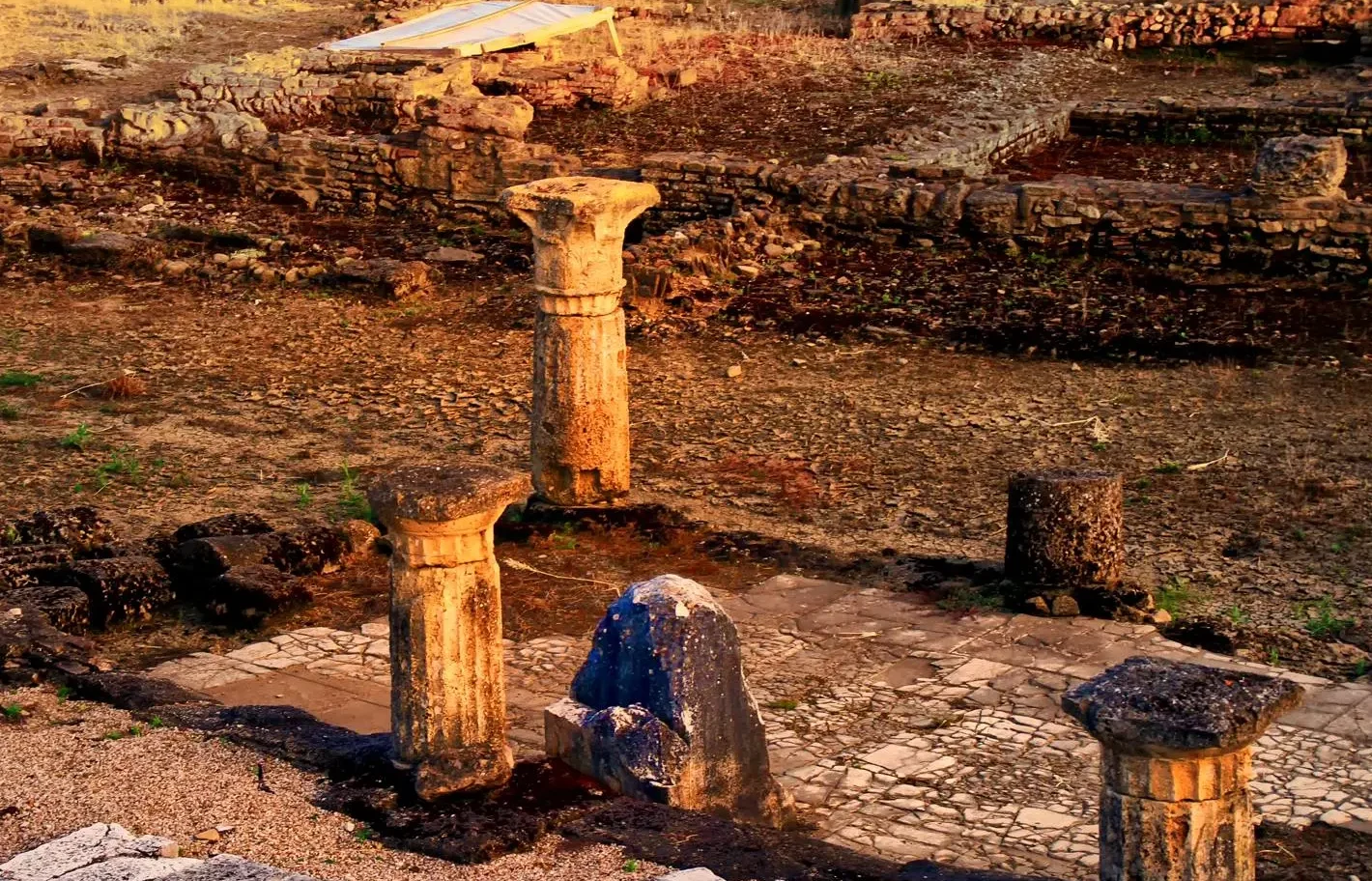
There, among the ancient columns, the trees and the light of Elis, history takes on a completely different dimension.
Because Ancient Olympia is not just a destination. It is a journey to the roots of Greek civilization.
And perhaps, upon leaving, you'll discover that the strongest travel memories aren't always the ones we photograph.
They are the ones that make us see the world with different eyes.
November 1 – March 31: 08:30–15:30.
The single ticket costs 20€ and the reduced ticket costs 10€.
It covers the archaeological site, the Archaeological Museum and the Museum of the History of the Ancient Olympic Games. The official website of the Excavations Museum also mentions its coverage by the single ticket.
📚 Historical documentation of the article
For the research, I mainly used official archaeological sources and academic material.
1. Ministry of Culture – Archaeological Museum of Olympia. Presentation of the collection, the most important works and the history of the museum.
2. Ephorate of Antiquities of Elis – Presentation of the Archaeological Museum. Documentation of the exhibits, the helmet of Miltiades, the cup of Phidias and the collections.
3. Ministry of Culture – Temple of Zeus at Olympia. Historical information about the pediments, myths and sculptural decoration.
4. Cambridge University – Sculptures of the Temple of Zeus. Academic presentation of pediments and their artistic significance.
5. Archaeological Museum of Olympia – Victory of Paeonios. Detailed information about the inscriptions on the base and the historical connection with the Messenians and Nafpaktians.
6. Academic study on the votive offerings of the Persian Wars. Historical documentation for the Persian helmet and the Athenian inscription.